22/10/2026 01:25
Which Knot Did the Tutor Explain? YouTube Transcripts for Cambodian Macramé Workshops

A learner remembers the tutor explaining which cord to move, but cannot find that sentence again. Replaying the entire tutorial is frustrating, especially with an unfinished knot on the table. For Cambodian macramé workshops promoting decorative wall-hanging classes or material kits, a usable YouTube transcript can make an existing demonstration easier to revisit. The practical task is to connect understandable words with the right moment in the video. This guide follows a hypothetical workshop preparing a Khmer-language lesson for promotion, explains how to test its transcript, and shows why an SMM panel service cannot substitute for clear instruction or demonstrate genuine demand.
1. Start with a question learners actually need to revisit
In this hypothetical example, a small Phnom Penh workshop teaches beginners to make decorative cotton wall hangings. Its demonstration includes attaching cords, forming a knot and checking the finished row. A learner asks which outside cord moves first when the second half begins. That question gives the owner a precise review task: can someone locate the relevant spoken explanation and watch the movement without searching through unrelated preparation?
Choose one published lesson and one recurring point of confusion. Write the question in the language learners use, then ask the tutor to identify the matching sentence in the recording. Avoid beginning with a broad objective such as making every video more professional. A narrow task exposes whether the problem is missing words, inaccurate captions, poor timing or an action the camera never captured. Each problem needs a different correction.
2. Understand what the transcript offers
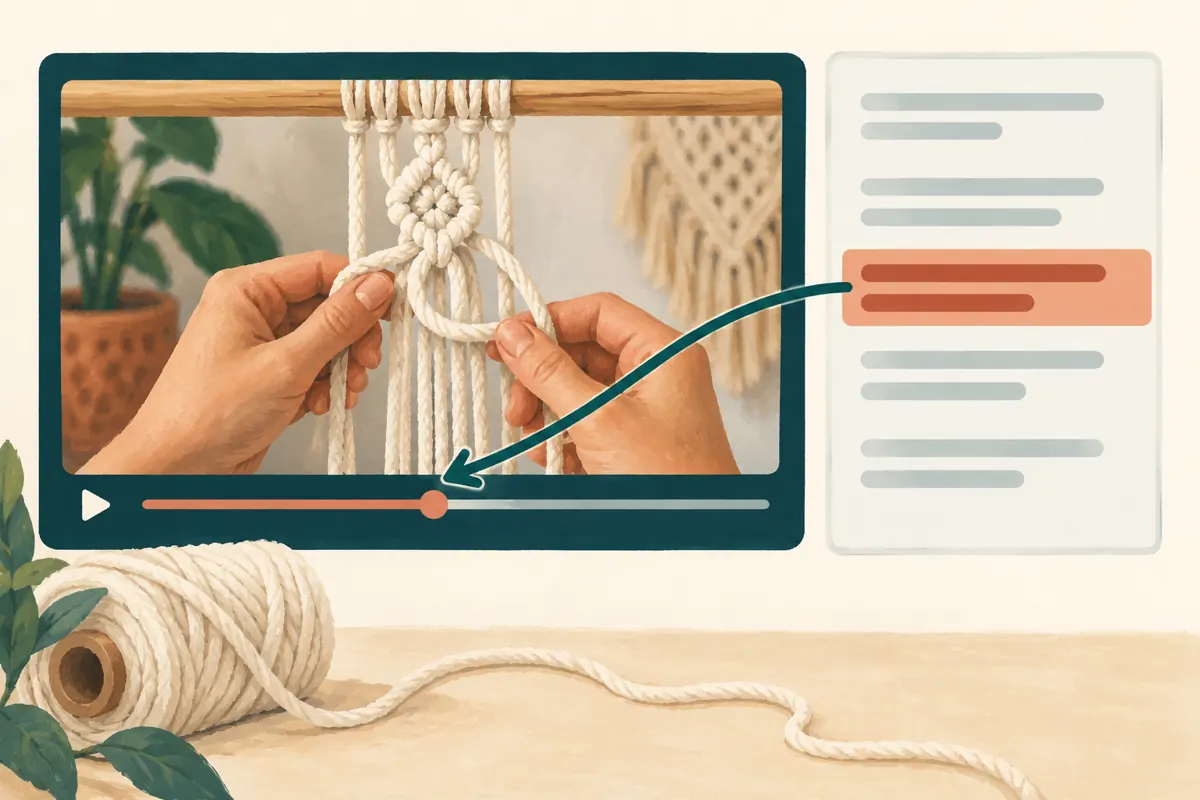
YouTube says videos with captions have a full transcript. Viewers can open Show transcript from the video description and select a caption line to jump to that moment. This creates a useful route from a remembered explanation back to the demonstration. The instructions come from YouTube’s official guide, [View video transcripts](https://support.google.com/youtube/answer/15930243?hl=en).
Treat the transcript as a way to navigate spoken instruction. It cannot reveal a cord hidden behind the tutor’s hand, explain an unspoken movement or prove that a learner has understood. For this workshop, the desired result is modest: the learner finds the sentence, returns to the relevant action and has enough context to continue. A clear transcript supports the video; the visual demonstration still carries information that words alone may not communicate.
3. Check the lesson from a learner’s device
Open the ordinary viewing page on a phone used for your review, rather than relying entirely on the editing screen. Expand the description and look for the transcript option. Select a line near the knot explanation and observe where playback starts. Record what you actually see on that device. Do not promise customers a particular button position or transcript search field without checking their viewing experience.
Repeat the exercise on a larger screen if staff commonly answer questions from a computer. If the phone route is difficult to explain, prepare a simple fallback: tell learners approximately where the demonstration begins and describe the visual cue to look for. For example, the hypothetical tutor could say that the relevant explanation starts when the two outside cords are spread apart. This remains useful when a learner cannot locate the transcript control.
4. Prepare captions before advertising transcript access
If captions need to be added, YouTube documents a route through Studio: open Subtitles, select the video, add the language and choose an available caption method. Its guidance includes uploading caption files and typing captions manually. Auto-sync has language and source-audio requirements, so do not assume it will handle a Khmer recording automatically. Follow [Add subtitles & captions](https://support.google.com/youtube/answer/2734796?hl=en) and review the options actually available.
Assign the work to someone who understands both the spoken Khmer and the craft vocabulary. Give that person the final video, the tutor’s preferred names for the cords and any material terms that might be confused. Ask for a faithful record of the explanation, not a rewritten sales pitch. Keep the reviewed caption file or working text with the lesson records so a later correction does not begin from memory.
5. Review meaning before polishing presentation
Listen to the target passage while reading its text. Pay special attention to direction, sequence and negative instructions. In a hypothetical recording, confusing an instruction to hold a cord with one to pull it could change the action completely. Check whether references such as this cord or the other side still make sense when a learner enters halfway through the lesson. If they do not, the original explanation may need improvement.
Next, inspect the surrounding sentences. A line that sounds complete may depend on a condition stated just before it, such as keeping the centre cords stationary. Preserve that relationship when reviewing the text and timing. Do not silently replace incorrect spoken instruction with different caption wording and assume the lesson is fixed. When speech and action conflict, arrange an explicit correction or a clearer recording before promoting that passage.
6. Test the jump with the cord sample in front of you
Read the transcript until you reach the explanation selected for review, then use that line to return to the video. Watch whether the hands are still preparing the movement or have already completed it. The useful test is practical: can a beginner see what changes? A technically accurate sentence arriving after the decisive motion can still leave the learner uncertain about which strand went where.
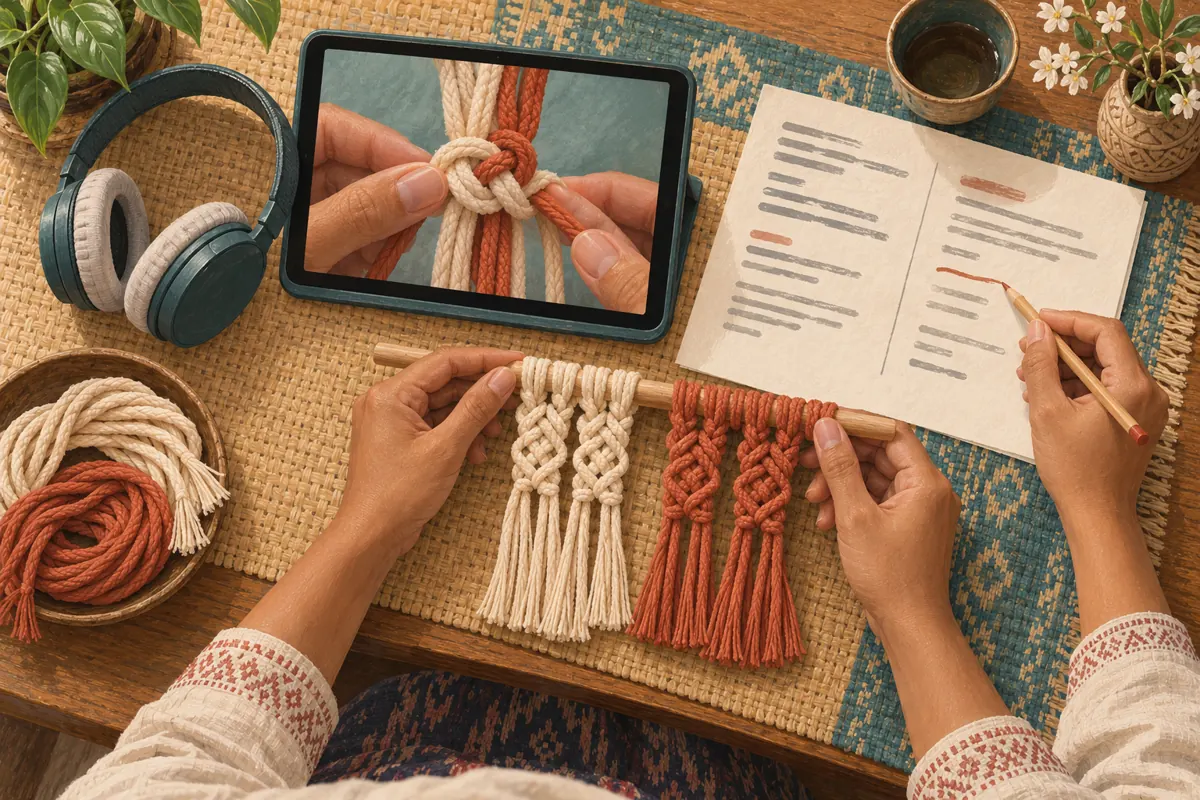
Place a simple decorative sample beside the review device. Recreate the starting position, play the passage and pause where needed. Ask whether the tutor names the cord before moving it, whether fingers obscure the crossing and whether the finished arrangement stays visible. Record problems separately as wording, timing or camera visibility. This prevents a caption editor from being asked to solve a filming problem and helps the workshop choose the smallest effective repair.
7. Give Khmer terminology a consistent working reference
A Cambodian workshop may use a Khmer explanation alongside an English knot name found on packaging or in a supplier’s catalogue. Create a short internal vocabulary note connecting the tutor’s chosen term with the object or movement it describes. Include an image reference where necessary. Consistency matters because a learner may remember the everyday explanation while a staff member remembers only the imported product term.
Keep that note separate from the transcript. It guides reviewers without turning captions into a glossary full of words the tutor never said. If the workshop also prepares an English translation, ask a competent reviewer to check the relationship between the two versions. Do not assume that an elegant translation preserves which cord moves or which side stays fixed. Test the actual instructions against the visible sample, especially where similar terms describe different actions.
8. Promote the learning benefit with an honest invitation
Once the passage works, write a post around the question it answers. For the hypothetical workshop, a suitable message would invite beginners to revisit the second half of the knot and follow the spoken explanation in the transcript. Show the same sample that appears in the lesson. Avoid implying that a short demonstration contains the entire paid class or that watching it confirms a booking.
Keep the next step distinct. Someone seeking help with a knot may need the tutorial; someone considering a class needs current session information; someone buying cord needs material details. Give staff a prepared response for each situation. Share the lesson where it is relevant and permitted, including replies to genuine questions. This makes promotion useful even before any enquiry arrives and reduces the temptation to describe public engagement counters as proof of class interest.
9. Apply a policy check before any SMM panel request
The supplied catalogue includes the exact public service name “YouTube Like ~ Max 5k ~ 5k/days ~ Instant ~ 𝐍𝐎 𝗥𝗘𝗙𝗜𝗟𝗟”. Its name identifies a likes service, but the brief supplies no explanatory description. Treat the remaining wording as catalogue claims, not independently verified delivery conditions. It provides no evidence of caption editing, transcript review, Cambodian participants or workshop enquiries.
YouTube prohibits artificial increases in engagement metrics and warns that a hired promoter’s actions can affect the channel. Do not proceed with a service that artificially inflates engagement. Consult the official [Fake engagement policy](https://support.google.com/youtube/answer/3399767?hl=en). For this lesson, spend the review effort on accurate instruction and relevant distribution. Purchased engagement cannot establish genuine interest, sales, ad delivery or Cambodian users, and a larger like count would not tell the tutor whether learners found the correct cord.
10. Use a small acceptance test and record the decision
Ask a colleague who did not edit the captions to find the selected explanation without coaching. Give them the learner’s question and the viewing link. Observe where they hesitate, whether they choose the intended passage and what they think the instruction means. Their difficulty is diagnostic feedback, not a verdict on the whole workshop. Record the exact obstacle instead of writing only that the video was confusing.
Use a simple decision process. If the words are wrong, correct the captions. If the words are right but the entry point is awkward, review timing and surrounding context. If the action is invisible, improve the demonstration. If the task works, approve the specific lesson for the planned promotion. Keep the reviewer’s name, review date, video reference and unresolved issues together. Later enquiries can guide another lesson, but one successful internal test does not establish broad customer satisfaction.

Frequently asked questions
What should we do if learners cannot find Show transcript?
First, check the same video on the device they are using and confirm that captions are available. Avoid repeatedly sending instructions based only on your editing screen. Offer a practical fallback, such as the approximate point in the lesson and a distinctive visual cue. Record the device and viewing context so your team can investigate the actual difficulty.
Should we add extra Khmer keywords to the transcript?
Keep captions faithful to the recording. Adding unrelated search phrases makes the text less dependable for someone following a movement. Put useful explanations in an appropriate accompanying description or learning note. If the tutor consistently uses an unclear term, improve the spoken explanation in future lessons and maintain a shared vocabulary reference for reviewers.
Can a transcript replace a written pattern?
Usually it should be treated as a companion to the demonstration. Spoken instruction may depend on gestures, a visible starting position or a sample already prepared off camera. A standalone pattern needs its own completeness check, including materials, sequence and illustrations where appropriate. Do not sell or describe a raw transcript as a complete pattern without reviewing it for that purpose.
How can we tell whether this work helped promotion?
Look for specific feedback: whether learners can find the passage, whether the same ambiguity continues to appear and whether enquiries concern the class or materials you actually offer. Keep confirmed bookings in your normal business records. These observations answer different questions, so avoid combining them into a single success claim or attributing every later enquiry to transcript improvements.
Is a likes service useful for checking whether the lesson is understandable?
No. A like does not report which sentence someone understood or whether they could follow the knot. Purchased engagement is especially unsuitable as evidence of learning or local demand. Use direct review questions and observation for that task. A service name also does not establish platform compliance; assess the actual method against YouTube’s rules before considering any promotion provider.
Explore the current service catalogue, create an account, or ask a specific question through support tickets.
- YouTube Help: View video transcripts
- YouTube Help: Add subtitles & captions
- YouTube Help: Fake engagement policy
Prepared with AI assistance. Illustrations explain the workflow and do not represent customer results.